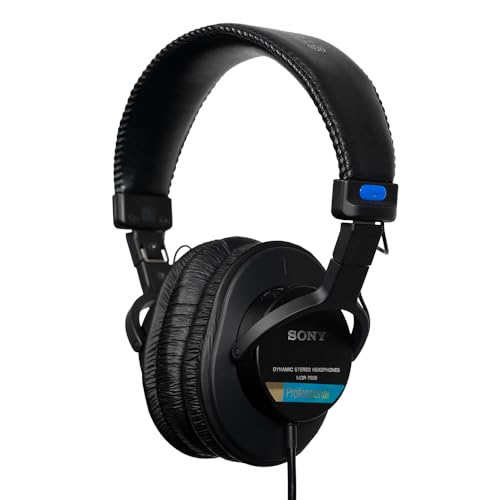
The Sony MDR-7506 entered production in 1991 and has not left it. You will find pairs in radio broadcast booths, film ADR studios, music control rooms, and podcast rigs - not because of marketing cycles, but because replaceable cables and ear pads mean studios can keep the same pair running for 20 years without a capital purchase. The coiled OFC litz-wire cable extends from 0.2 m at a desk to 3.0 m across a studio floor and springs back when you set the headphones down. No battery to charge, no Bluetooth radio to pair, no firmware update to apply before your session starts.
The 40 mm dome driver uses a CCAW (copper-clad aluminium wire) voice coil - lighter than pure OFC copper - which is one reason the distortion spec lands at ≤ 0.05 %, exceptionally clean for a moving-coil driver at this price point. The closed-back cup provides the passive isolation broadcast engineers need when monitoring live-to-air: ambient noise leaks into the microphone if the headphone bleeds, so the seal matters.
What the specs tell you
63 Ω impedance. Slightly above the 16–32 Ω most consumer earphones present. A modern smartphone drives this to adequate volume, but a headphone amplifier or audio interface - which has a much lower source impedance (typically < 5 Ω) and greater voltage swing - produces better damping control of the driver, tighter bass, and more dynamic headroom. The MDR-7506 was designed for professional mixing consoles and interfaces. It works from a phone, but it performs better from a proper amp.
106 dB/mW sensitivity. To reach 83 dBSPL (a comfortable casual listening level), the MDR-7506 needs approximately 50 μW. To reach 100 dBSPL, it needs about 6 mW. Both are trivially achievable from any source device. The high efficiency means the volume control rarely exceeds the midpoint, keeping quantisation noise from the DAC well below the noise floor.
≤ 0.05 % total harmonic distortion at 1 kHz, 1 mW. THD measures the energy of the second and higher harmonics as a percentage of the fundamental. At 0.05%, the harmonic content is −66 dB below the fundamental. Psychoacoustic research places the audibility threshold for harmonic distortion at approximately −50 to −65 dB depending on program content and listening conditions. The MDR-7506 sits right at the edge of detection in ideal conditions - which is why engineers describe the driver as very clean despite being a mid-range dynamic transducer by absolute standards.
CCAW (copper-clad aluminium wire) voice coil. Aluminium is roughly one-third the density of copper. A wire strand with the same cross-sectional area carries more current-per-gram in aluminium than copper, so CCAW reduces the moving mass of the voice coil while maintaining sufficient conductivity. Lower moving mass improves transient response - the driver follows fast attack events (cymbal hits, consonants in speech, plucked strings) with less overhang. The MDR-7506’s dome construction distributes stress evenly and reduces high-frequency breakup compared to a flat-diaphragm driver.
OFC litz-wire cable. Oxygen-free copper removes dissolved gases that form grain boundaries inside the conductor. Litz (Litzendraht) wire bundles individually insulated strands: each strand carries the full conductor cross-section rather than just the skin - the surface layer that AC current tends to occupy at high frequencies due to the skin effect. At 20 kHz, skin depth in copper is approximately 0.47 mm; a litz bundle of strands thinner than 0.47 mm diameter maintains uniform current distribution across the full audio band (20 Hz – 20 kHz).
Coiled cable, 0.2 m – 3.0 m. A spring-return coiled cable is always the right length: 0.2 m when you are seated at a console with the source on the desk; 3.0 m when you need to walk to the control room window. It stores kinetic energy when stretched and returns to rest without tangling. Studio engineers dislike straight cables because they pool on the floor, catch on stands, and tangle during source changes.